Saturday, July 20, 2013

In the Matter of Trayvon Martin and George Zimmerman

There is no reason that Trayvon Martin should have had to die.  There's simply no reason.

His death is not right (in my sense of right and wrong).  It is not just, even if it can be legally justified under the laws of Florida.  Being legally justifiable does not make something right, nor just.

Just walking around
Trayvon had a right to be there, in that gated neighborhood.  He was staying there temporarily.  Just walking around, he was not up to anything wrong.

In fact, before the encounter and confrontation, each man was just doing his own thing, if you will.  Trayvon was just going to the store and returning to the home he was visiting.  George was just doing his rounds of watching the neighborhood.  Neither of them knew the other. Neither of them had any beef against the other.

And, if on that evening of February 26, 2012, each of them had simply just kept on doing their thing, neither would have nationally known names.  Neither of them would have been in a scuffle.  Trayvon would still be alive today.

Let me first suggest that no one, regardless of their opinion on this matter, would have wanted Trayvon Martin to die.  Even the most ardent defenders of George Zimmerman will only defend George's innocence, that, under the laws of the State of Florida, he had a right to use deadly force in the scuffle at a point when George felt he had reason to believe his life was threatened.  They would defend George's right to self-defense and to stand his ground,  But, I will suppose that none of them believed that Trayvon deserved death.

Why did he have to die?
So what went wrong?  Why did Trayvon have to die?

Here the details are only partial.  We don't have a video replay to document the events, step-by-step.  Piecing things together, we know that George called the police after seeing Trayvon.  There had been incidents of other crimes in the neighborhood, and apparently George suspected that Trayvon might be up to criminal intent.

About 7 1/2 minutes after George called the police, a shot is heard by a neighbor calling the police.

Somewhere in those tragic 7 1/2 minutes, Trayvon realizes he's being followed and runs, getting away from George.  Despite instructions from the 911 operator, George pursues Trayvon on foot.

In the last 3 minutes of Trayvon's life, the encounter escalates.  Somehow George finds Trayvon.  At some point the encounter turns into a scuffle.  One of them shouts for help.  A neighbor sees the fight and calls 911.

And then at 7:17 pm, the shot is heard.

Within a minute, police arrive.   Not too much longer, Trayvon dies.

Beyond these events, we hear how different people want to interpret the situation.

Some will say that George escalated things by not obeying the 911 operator's instructions not to pursue.  If he didn't pursue, when the police arrived, they might have only questioned Trayvon and interviewed George, avoiding the fatal encounter.

Others say George was just doing his job.  He found someone who might be up to no good, pursued him.  And when he felt his life was threatened in the scuffle, he defended himself.  They say he did nothing wrong.

How Doing "Nothing Wrong" Leads to Fatal Results
Why does the "he did nothing wrong" scenario end up in Trayvon's death?

Some will say that it was Trayvon who was attacking George.  And when the encounter changed to the point Trayvon threatened George, then George was justified in defending himself.

But on the other side, were Trayvon's actions tantamount to "standing his ground" when he felt threatened by Georges pursuit?

On another perspective, if not for George's gun, the scuffle may have been simply a "mano-a-mano" fist fight, perhaps with bloody results, but not with fatal results.  The deadly weapon was the variable that allowed the scuffle to turn fatal.

The "Loophole" in Stand Your Ground
On the surface, self-defense makes sense.  You're just minding your business, and some criminal comes up to you and threatens you.  Shouldn't you be able to defend yourself?  Most people will say this makes sense.

But now, change the nature of the encounter.  Say there's no one just attacking you out of the blue.  You're minding your business and so is the other person.  But you think the other person may be up to no good.  Then you do or say something, and the other person feels threatened.  With both persons now feeling somewhat threatened, an encounter or scuffle or fight follows.  The fight escalates.  Now, if either or both of the persons fighting feels their life is threatened, they can simply kill the other person can claim they're standing their ground.  

Does this mean anytime two people get in a serious fight, the stand your ground provisions apply and one person is allowed to kill the other?

Does this mean that someone can now go around picking fights, getting the other person all worked up until that person attacks, and the person picking the fight can now kill that person, justified by stand your ground?

Is this a justification for injecting a fatal conclusion is what should just be a fight?

If George escalated the encounter by pursuing Trayvon to the point Trayvon felt threatened, who is responsible for the scuffle that followed. Why does George get to claim stand your ground if he started it?

The Law vs. Right-and-Wrong
Somewhere, I believe there is a gut sense of right and wrong that is violated here.  Sure, I listened to the trial and based on the evidence and law, George was correctly found "not guilty."   But that doesn't make him innocent or even right in his actions. 

Only a lawyer can say that right-and-wrong of the incident boils down the the last 2 minutes of the scuffle, when George felt his life endangered and shot Trayvon.  I believe reasonable people would look at all of George's actions to judge what is right or wrong.

Thus, my sense of right and wrong encompasses the entire incident, from the first moment that George spotted Trayvon.

My sense of right and wrong looks at all the actions of each individual.  When you do that, we see neither was completely a victim.

When George first spotted Trayvon, he was doing nothing wrong and had every right to be walking through the neighborhood.  But seeing this young man in a hoodie, George made a judgement that he was suspicious, and then decided to follow Trayvon.  Observing only his race and attire, George wrongfully assumed Trayvon might be up to something criminal.  This act made Trayvon a victim of unjustified accusation.  

As a victim of unjustified accusation, was not Trayvon justified for feeling concerned about being followed?  For Trayvon, there was not an apparent reason why this guy was following him.  So, would not be reasonable for Trayvon to run away to escape from being followed?  Yet, George may have interpreted Trayvon's running as confirmation that he was up to something.

So, the situation between the two strangers has escalated, with George in pusuit of a potential criminal and Trayvon angry about why this unidentified guy is following him.

For any person, regardless of age or race, being followed for unexplained reasons puts one on the defense.  Many of us have had some situation where they are followed by someone.  It happened to me once at age 22, when two men pulled me down and robbed me.

According to the event timeline, there was about 3 min. between the end of George's call to the police, when he said he lost track of Trayvon, and the shot that killed Trayvon.

Clearly, in those 3 minutes, the pair found each other.  After finding each other, somehow a  scuffle ensued and likely punches were laid on George.

While a fight is never justified, we can see where the emotions of each person could lead to it.

But, who was the instigator?  George took the first actions, and created the encounter.  Without his pusuit, the two would have gone on their own ways.

Yet, under the law and in court, we see George made into the victim, fearing for his life in a scuffle lasting 2 minutes at most.  

Think about this.  George is the guy with the gun.  Trayvon is unarmed.  If Trayvon knew George had a gun and was pursuing him, did not Trayvong have  the right to stand his ground and defend himself in the only way he could by using his fists, as he was unarmed.

Yet, under Florida law, it is George that is justified for "standing his ground" (ironic for a guy lying on his back, loosing the fight that he instigated.

My sense of right and wrong is both of them are wrong in fighting.  But, once the fight began, both of them can be justified in "standing their own ground."

Finally, if this incident was left to trained law enforcement and not this amateur, self-appointed armed watchman, there is no reason for the incident to end in death.  But, thanks to the provisions of Florida law, we have a young man dead for no good reason.

The death of Trayvon was not right.  It was not just.

Wednesday, June 26, 2013

Marriage and the Supreme Court

The high court issued two land-mark decisions on what is popularly called "same sex marriage."  In separate 5-4 decis-ions, the court's decisions came out with decisions favorable to supporters of same sex marriage.

We will shortly see the barrage of political spin on all fronts.  But, from my analysis, the court decided in a logical manner.

Defense of Marriage Act (DOMA) Decision
In this case, the court correctly determined that DOMA violated the constitution.  In simple language, since same-sex marriage contracts are equally legal as two-sex marriage contracts in certain states, the Federal Government is acting unconstitutionally by saying some of these valid contracts can be honored by, say the IRS or other Federal agencies, whereas other equally valid contracts are honored.  There is no simple logical or legal reason for this.   (Technically, DOMA was found to violate the equal protection clause of the Fourteenth Amendment, as made applicable to the United States through the due process clause of the Fifth Amendment.   Thanks to my friend Josh for the legal details.)

So, here's my analysis of the decision:
  • Simple logic:  This decision is simple as the Feds can't uphold some marriage con-tracts while not upholding other mar-riage contracts.  Fair-ness demands they honor them all or honor none of them.
  • States rights:  So, today, the left is championing state's rights to define marriage, whereas certain conservatives who oppose the decision want the heavy hand of the Federal government to say "wait, we have some overriding principal and we'll impose our will on everyone."  Here, these conservatives are wrong.  They proclaim a weaker Fed, until some issue comes up when they can control the lives of those who differ from them.
  • Theocrats:  We will hear religious leaders and religious politicians decrying the government cannot redefine the "traditional" marriage.  But these are the leaders who what to impose the principals of their interpretation of religion on all.  The want to encode tenants of religion into national law.  Here I have many things to say:
    - I do not believe in any encodement of any religious principals in national law.  This is both unconstitutional and against my religious beliefs
    - I am a Christian and I belief in teachings of Jesus Christ.  Jesus clearly had many problems with the high priests and scribes who wanted to hold all to their beliefs without walking their talk.  The theocrats are the high priests and scribes of our days and we must not follow them as they do not have authority in the eyes of God.
How Should Marriage Be Defined and by Whom?
We have been delivered to this point in time when this is the real question and this is where all sides want to prevail.  But before I tackle the issue, we need to look at the background:  how did we get from marriage as a local mercantile contract between business partners to marriage as something that spans the realms of religion and government?

A Brief History of Marriage  (taken from a previous post)
Forms of committed relationships between a man and woman date back millennia in many cultures. In many of the earlier forms a woman was considered given to a man. In European history, this was often seen as more a business deal, arranged by the families, where the woman may have been given as part of a transaction involving material goods.

Cultural traditions for marriage vary around the world and date back centuries, though the particulars typically evolved over the years. Often religious beliefs or superstitions were entwined in these traditions.

Formal state and/or religious recognition are relatively recent additions. In Europe, the first example of requiring a religious ceremony of marriage was in the Catholic Church, after the 1545 Council of Trent. However, religions ceremonies did occur for centuries before this date, but they were optional. Civil marriages emerged in Europe in the 1700s and 1800s.

The emergence of state recognition of marriage, particularly in Europe, roughly parallels the transition from state religions to tolerance for multiple religious traditions. Before that, the bureaucracy of state and church were so intertwined that the need for separate state involvement was not needed.

Back to the Question at Hand
We, in western society at least, have over the last 200 to 300 years come to move marriage into the public realm.  But, the major religions still believe marriage is theirs to define.

Thus, the conflict between church and state to define marriage.  Even in some religions, such as Judaism and Christianity, there is a divide.   Some sects cling to what they call "traditional marriage" yet others do marry same-sex couples.

This is the driving force in the power struggle for defining marriage:  does government in a multicultural society let the traditionalists, who may claim this is how it always was and always shall be?  Does government simply put it up to a vote?

As I have no trust of the theocrats, I can't accept any one view point strong-arming their opinion into law.  And, we all know the "Bible-based" marriage argument is weak, in light of many figures in the Hebrew scriptures who were unfaithful, or who had a lover on the side, etc.   The argument that it takes a man and a woman to conceive has a degree of merit, but, even in the arguments at the Supreme Court, the justices pointed out that marriage is not solely for propagation.  And there are many 2-sex couples who can't conceive as well as many ways that infertile couples and same-sex couples can conceive and have children.

In an equal manner, I don't like the idea of the definition of marriage being decided by a elected politicians or a ballot question or a judge in some court case.   Either, we end up with what DOMA tried to do, namely use the strong arm of the Fed to define marriage, or a patchwork of state-by-state decisions.

The Many Facets of Marriage
So, is marriage mostly for the propagation of the species?  Or for the committed, intimate relationship of soul-mates?  Or for the financial security of one or both spouses?  While traditionalists would say "all of the above" this is not always the case.  Some couples don't want to have children.  Some marry later in life so it's more about companionship.

Marriage has a somewhat different meaning and purpose for each couple, even if the traditionalists only put forward the model of a young couple marrying and having a family.

What Does My Faith Tell Me?
While many Christians will disagree with me, I can't say that a same-sex relationship is an abomination in the sight of God. I think we have to look hard at the teachings of Jesus and how Jesus lived and interacted with the people of his time on earth.   Yes, Jesus attended a "traditional marriage" at Cana and help out with the wine shortage.  Many take this as his endorsement of "traditional marriage,"  which it may be.   

But Jesus, unlike the scribes and pharisees of his day and the theocrats of our time, did not preach the prescriptions of what we should not do.  These folks love to be seen in public doing "good" things and following the rules.

Rather, he focused us on the greatest commandment of loving God and neighbor.  This love within needs to bring us a change of heart.  We must accept all, especially those on the fringes.  In Jesus' day, this was the tax collectors, prostitutes, and widows.  In our day, when we see who the theocrats rail against certain groups, those in the fringes include the undocumented aliens, minorities, LGBT folk (aka, "abominations"), the poor and homeless.

I know many same-sex couples who are motivated by love for each other.  I have many LGBT friends who have a strong faith in the Lord.  They don't exhibit the vile and hatred we see from the theocrats.  So, the question to me, is who is closer to the kingdom of God?

What to Do?
My proposal is simple: get the government out of the marriage business. A good pragmatic Libertarian has to always ask: “Does it make sense for the government to be involved in this?” I say: “No!”

The states should deal with legal contracts, which is one of the necessities of “being married” -- for example, ownership of common property, joint custody of dependents, rights related to health care, inheritance etc. So, I say any couple should be able to draw up a state-recognized legal contract regarding these matters.

And let the marriage ceremony return to the cultural traditions of the couple, be they religious or non-religious. Those traditions that recognize same-sex marriage can perform them; those opposed don’t have to.

Freedom and choice for all with no government intervention. That’s my solution.

Monday, January 2, 2012

Off and Running!


With tomorrow's Iowa caucuses, the candidates are off and running  nomination as the Republican candidate for President.  While Romney might have the best odds at getting the eventual nomination, things are still up in the air as 2012 begins. 

More than many of the past races, the present Republican field has provided great fodder for political pundits and comedians alike.  And I can only image that foreign political observes must be shaking their head saying "Is that the best examples of leaders that the great American nation can field?"  It's embarrassing at times.

What am I looking for?  Someone who shows intelligence,  an understanding of national and international issues, and able to think for themselves.  I believe God gave us a brain and we should use it.  I have little respect for those so wedded to policies and a political agenda that they cannot even think for themselves.  Finally, we need a candidate that can truly lead us forward from this disastrous partisan politics of today, where there is no room for compromise and each side feels it must sabotage the other's efforts.

But I don't think this candidate is out there.

On the Republican side, so far, there's been the steady, boring candidate, Mitt Romney, and a progression of contenders who rise like shooting stars and just as quickly fall back to earth.  

At first, I thought maybe Michelle Bachmann would be the intelligent Sarah Palin, but soon we found she had difficulty with the facts.  And as someone so tied into the religious right and Tea Party folk, there's no room left for her to think on her own, even if she wanted to.  Then it was Rick Perry's turn, but he had trouble remembering what his handlers told him to say.  Newt also rose, as he is both intelligent and able to speak his mind.  Unfortunately, he has some ideas (e.g., putting school children to work clean their schools in lieu of union janitors), but I'm sure he'll be putting his foot firmly in his mouth a few times.  

Outside the shooting stars, Ron Paul appears to be intelligent and he claims to be a libertarian.  But only some of his policies would meet the libertarian test and he carries the stigma of unelectability.  Huntsman and Santorum are too far behind at this time.

Let's see what happens!

Saturday, December 31, 2011

Tea Party Reps Fail

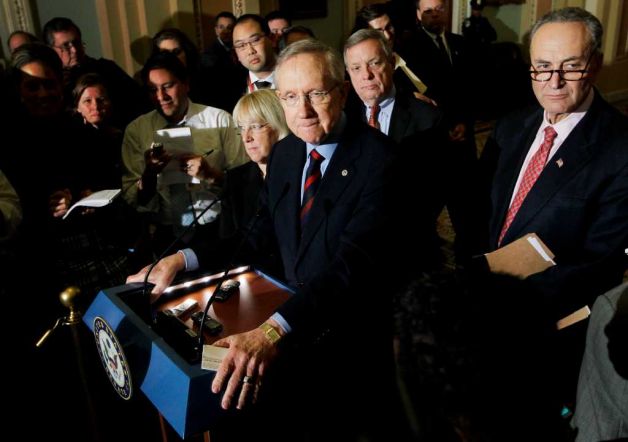
Boehner and Reid
With the recent passage of the extension of payroll tax cut, we have witnessed a major failure by the new Congressmen who align themselves with the Tea Party.  While the Tea Party and other conservatives (e.g., Michelle Bachman) have generally considered the ending of temporary tax breaks as de facto tax increases, many have been strongly opposed to this tax break that benefits mostly lower and middle income tax payers.

Why?  On the record, they say it's because it doesn't really stimulate the economy.  But the unspoken reason is simply that Pres. Obama supports the idea, so they must oppose anything that Obama supports.

Still, Republican leadership knows there's no need to alienate so many middle class voters 10 months before the elections.  That's political suicide.  They know this middle class tax cut is political candy (http://rachy-viewsofalibertariansocialist.blogspot.com/2011/12/political-candy-aka-payroll-tax-cut.html) and you don't steal candy from the voters!  Even some conservative commentators couldn't figure out the hard line opposition by conservatives and Tea Party reps.

We all know that a two month extension passed Congress and was signed by the President only days before Christmas.  But the scandal for every Tea Party voter is how each and every one of the Tea Party Congressmen failed to stop this.

It would have been so easy for just a single one of them to kill the bill.  Speaker of the House John Boehner resorted to some old fashion, quick-gabble methods.  With very little notice, he reconvened the House and put up the bill for passage by unanimous consent.   Granted some Tea Party reps. couldn't make it back to DC in time with such short notice, but some could.  And it would take only 1 Tea Party rep. to show up to stop it by opposing the unanimous consent.

But not a single one of them were there.  

In other words, the entire Tea Party delegation simply did not show up!  Is this not the classic complaint against government and government workers, namely not showing up to do their job?  Clearly, this should motivate all Tea Party voters to vote them all out for this failure to show! 

(Personally, I'm loving observing this dysfunctional family known as the Republican Party!)

Wednesday, December 7, 2011

Political Candy (aka, Payroll Tax Cut)

The political debate over whether or not to extend the payroll tax cut tells us a lot about what candidates think of the American public. This debate tells me that the politicians of all persuasions think of the public as children and the payroll tax cut is political candy. It's only a short-time sugar high, but most people want their political candy! 

First, we see President Obama, feeling the pain of the average person in these tough economic times, saying now is not the time to end this tax cut. When the children are having a bad day, it just isn't nice to take away their candy. 

Then, we see various economists and others who are focused on our deficits saying they know what's best. Just because the children want their candy doesn't mean they should get it. They want to lecture the children about what's good for them and be firm: no candy! 

On the Republican side, the candidates for President are divided. Mitt Romney and Ron Paul like continuing the tax cuts. Michelle Bachmann and Rick Perry don't like them. Bachmann says they're not working. But taking away their candy is no way to win votes. In a similar manner, Republic Party leaders realize they don't want Republicans to be tagged with taking away a popular tax cut going into a Presidential election year. But the rank-and-file, especially the Tea Party folk, disagree. 

I predict the tax cut will live for one more year. I see the Republican leadership twisting arms with the argument that in a close election, this issue could loose them their chance to capture the White House.

Back to the Blog

The last year has taken me away from blogging.  But, with the Presidential election coming up and the great fodder provided by the Republican candidates, I just have to get back to it!


More posts to follow.

Monday, February 21, 2011

Welcome to v2.0 of the Post 9/11 World

The current popular uprisings in the Middle East are proving the arch rivals of 9/11 wrong.

The neoconservatives of President George W. Bush's administration said democracy must come to the Middle East, but tried to install it by force, such as the invasion of Iraq. They were wrong. Democracy is coming from popular uprising, not unlike the way it emerged in the United Stated or in India.

Osama bin Laden and al-Qaida sought to overthrow the oppressive oligarchies through violent means. Today, bin Laden is far from center stage, as the oppressive oligarchies through nonviolent means.

Any day that both misguided neoconservatives in the US and misguided violent religious terrorists worldwide are proven wrong is a great day for the freedom of all people!